
Bottle gourd (
Lagenaria siceraria) is a widely grown tropical vegetable which has high carbohydrate content. oil can be extracted from the seed kernel and is used in hair care products. the hard shells of the bottle gourd can be used as utensils, or floats in fishing nets and even musical instruments, due to its resonating property.
soil and climatebottle gourds require well drained and sandy loam soils for its good cultivation. it cannot tolerate higher amounts of acidity, alkalinity or salinity. pH range is between 5 to 5.5 . when soil conditions are not optimum, then production of female flowers is greately affected.
 ten days after sowing. thinning out has to be done & min of 2 seeds must be retained in every bed
 21 days after sowing.
it can be grown almost in all climates, however, too much rainfall is not good. optimum temperature range is between 30 to 35 degrees during day. if temperature is very high, then more number of male flowers are formed thereby decreasing yield.
LAND PREPARATION, IRRIGATION AND FERTILIZER MANAGEMENTSince we are discussing monsoon techniques for growing bottle gourds, the land selected must have good drainage. to attain this at least 3 repeated ploughings must be done. raised seed beds are made up to height of 30 cm & distance between beds must be maintained at minimum 2 meters.
 irregular leaf shape is due to heavy rainfall & pest attack. spraying with systemic insecticides like dimethoate @ 1 ml per litre every week till plant is healthy is done.
 lush green leaves indicates good nitrogen in the soil
 in the presence of optimum sunlight, the leaves are able to prepare their own food & the plants appear much more healthy
irrigation is not given during monsoon , but when there is dry spell, light irrigation must be done just to replenish soil moisture. in summer irrigation is carried out thrice a week. if proper mulching is done, irrigation can be reduced to twice weekly.


 the 3 photos above show the crop development after a 35 days after sowing. care must be taken to see that the growing vines are free from developing weeds, or it will hinder harvesting.

 development of fruits, fruit setting seen
requires good amounts of organic manure. since it is a long duration crop, it is highly beneficial to add manures in split doses. bulky organic manures can be added to the soil every 20 days, while it is good to add complex fertilizers at least once every month.
it responds great to foliar applications as well. the number of female flowers can be increased using plant hormones like NAA, naphthalene acetic acid @ 1 ml per litre, just during flowering stage.
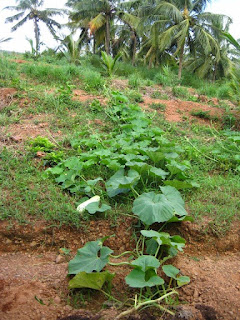 a healthy bottle gourd plant, which seems to be climbing. the vines can grow up to 20 feet, if left unchecked & hence thinning out is done to avoid overcrowding. also distance is maintained between beds for this reason
 flowering can be observed. the plant continues to grow & the vines cover the complete area giving a carpet like appearance.

 fruit setting in the above 2 photos
 the green carpet coverHARVESTING
bottle gourds can be harvested after 55 to 75 days after sowing. care must be taken while harvesting to see that proper tender and ripe fruits must be harvested. the developing tender fruits will have green color & the seed coat & rind are tender. it is best to harvest at this stage. sometimes , harvesting is done depending on the size it attains. smaller fruits are in great demand as compared to bug sized fruits.
when the color changes from green to white, the seed coat and rind hardens & then it becomes over ripe & unfit for consumption. such fruits are kept for formation of seeds, which can be extracted once the fruit completely dries up.

some varieties can yield up to 20 tonnes per hectare.
NOTEIn many cases, especially during monsoon, the growing vines are pruned to allow more lateral branching. vines which are bit old & semi hard are pruned to get the desired result. in some other cases, the vines are allowed to train on coconut ropes grown on bower of bamboo sticks. this is done to prevent the developing fruits from coming in contact with soil & rotting.
Photos and content by Pritham 'Heavy metal farmer' denzil dsouza


